The margin is compensation for being wrong
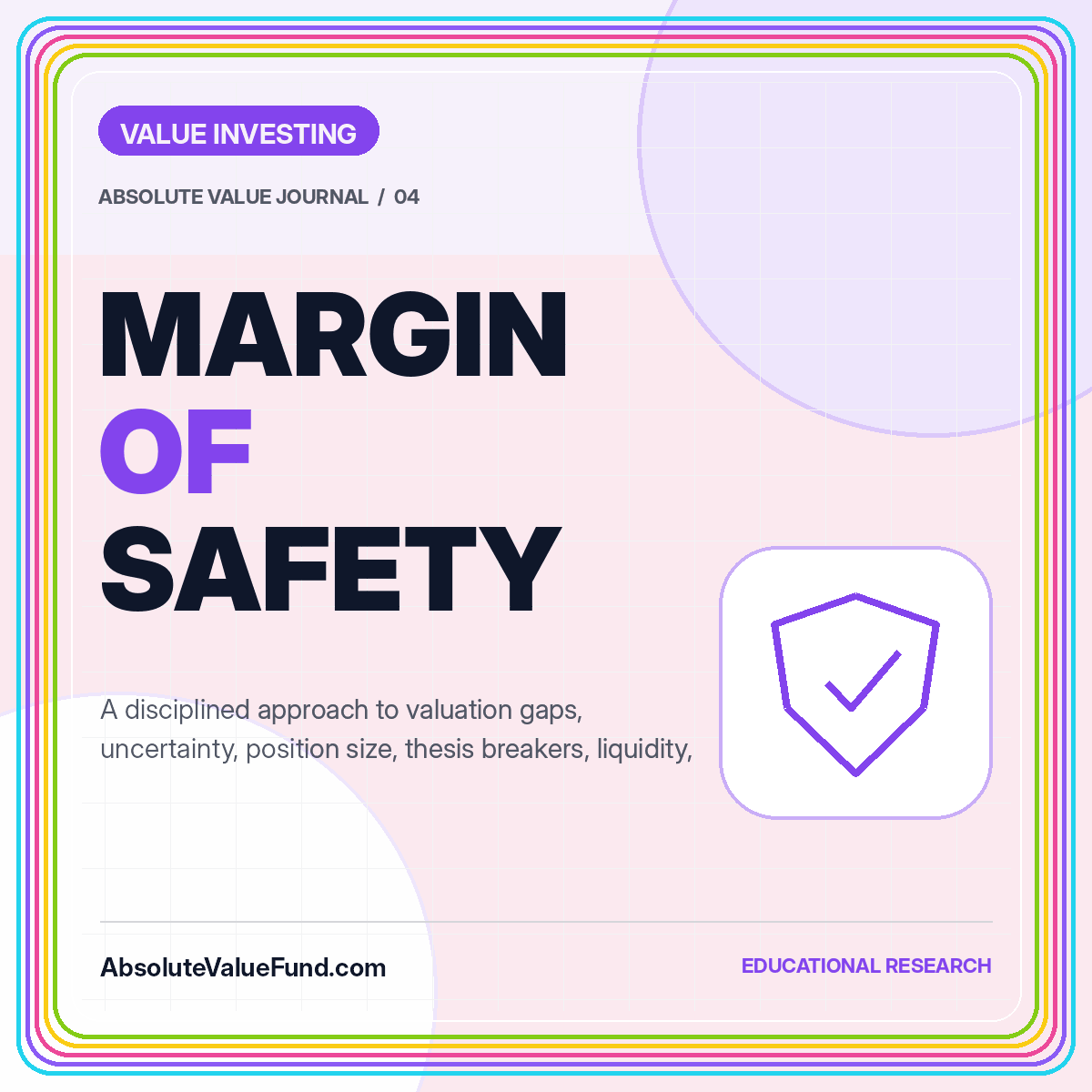
A margin of safety is the gap between the price paid and a conservative estimate of value. Its purpose is not to prove that the investment will work. It is to create room for forecasting error, adverse events, and normal business variability. The less predictable the asset, the wider the gap should generally be. A stable, lightly leveraged business with recurring demand may justify a narrower range than a cyclical, highly financed, or rapidly changing business.
The concept is often reduced to a percentage discount, but the quality of the underlying estimate matters more than the arithmetic. A 40% discount to an inflated valuation provides less protection than a 15% discount to a resilient cash-flow base with conservative assumptions. The investor must examine both sides of the ratio: the reliability of estimated value and the price actually paid.
Build conservatism into the estimate before the discount
A sound process does not create a bullish base case and then declare a margin of safety because the market price is lower. Normalize earnings, include maintenance capital, use a realistic share count, account for debt and other claims, and stress the assumptions. The valuation should already reflect a sober view of the business. The price discount is an additional layer, not a substitute for rigorous inputs.
The CFA Institute’s discussion of margin of safety emphasizes that there is no universally correct percentage. That is a feature of the concept, not a flaw. The required margin depends on estimation error, asset quality, financing, liquidity, and the investor’s opportunity set. A mechanical threshold can hide differences that matter.
Distinguish uncertainty from risk of permanent loss
Uncertainty means outcomes are difficult to forecast. Risk of permanent loss means the investment may be impaired in a way that cannot be recovered through time. A young company with strong liquidity may have uncertain earnings but limited near-term solvency risk. A mature company with predictable revenue may still face permanent-loss risk if it carries too much debt or depends on a single regulatory privilege. The margin of safety should respond to the mechanism of loss, not only to historical price volatility.
What to test
Ask how the investment can fail. Customer defection, technological substitution, refinancing, fraud, litigation, dilution, commodity exposure, or poor capital allocation may each require a different form of protection. Sometimes the right protection is a lower price. Sometimes it is a stronger security in the capital structure, a covenant, a hedge, or no position at all.
Position size is a second margin of safety
Even a carefully researched investment can be wrong. Position sizing limits the damage from errors that valuation cannot anticipate. A position should reflect expected return, downside severity, probability of impairment, liquidity, correlation with existing holdings, and confidence in the evidence. High upside does not justify a large position when the downside includes permanent loss or when the outcome depends on a narrow set of events.
Sizing should be considered at both entry and full exposure. An investor may begin with a smaller position while evidence develops, but staged buying should not become an excuse to average down automatically. Define the maximum weight, the evidence required to increase it, and the conditions that prohibit adding. The total risk can also exceed the visible weight when several holdings depend on the same macro factor or financing market.
Use thesis breakers, not price targets alone
A price target describes an expected destination. A thesis breaker describes evidence that invalidates the route. Examples include a loss of a key customer, leverage rising beyond a stated limit, a unit-economics threshold failing to improve, governance changing, or management allocating capital in a way that contradicts the thesis. These conditions should be written before the position becomes emotionally important.
Price declines deserve investigation, not an automatic response. If the decline reflects broad sentiment while the evidence strengthens, the margin of safety may improve. If it reflects deteriorating fundamentals, the old valuation may no longer be relevant. The decision must be based on updated facts, not the desire to recover the original cost.
Watch liquidity and path dependence
An investment can be attractive at the destination and still fail because the path is too demanding. Illiquid securities, levered positions, and assets with margin calls can force a sale before value is realized. A wide estimated discount does not protect an investor who cannot finance the holding period. Position size should therefore incorporate trading depth, redemption terms, borrowing arrangements, and the liquidity of the rest of the portfolio.
Portfolio implication
The same principle applies to personal or organizational cash needs. Capital required for near-term obligations should not be committed to a thesis that may take years to resolve. A margin of safety in price cannot replace a margin of safety in liquidity.
Avoid the value-trap pattern
A value trap is not simply a stock that remains cheap. It is an investment where the apparent value erodes faster than the price discount closes. Common patterns include structurally declining demand, recurring “one-time” adjustments, underinvestment, acquisition-driven accounting, weak governance, and leverage that transfers value to creditors. A low multiple can be a warning that current earnings are not durable.
Look for a mechanism that allows value to reach the investor. Free cash flow can be reinvested at attractive rates, used to reduce debt, distributed, or used to repurchase shares at a discount. Without disciplined capital allocation, an undervalued asset can remain undervalued while management consumes the cash. Catalysts are not mandatory, but the ownership claim should have a credible path to realization.
Portfolio context changes the answer
A position that is modest on its own can be large in combination with similar holdings. Banks, insurers, real estate, and leveraged credit may all be sensitive to funding stress. Several technology companies may depend on the same spending cycle. Correlation can rise in a crisis, particularly when investors must sell liquid assets to meet obligations elsewhere. Position sizing should aggregate common drivers rather than treating ticker symbols as independent risks.
Opportunity cost also matters. A large position in a moderately attractive idea can prevent investment in a later, better opportunity. Holding some liquidity can be rational when valuation ranges are wide or when the portfolio already contains hard-to-sell assets. The goal is not maximum conviction in each holding; it is durable compounding at the portfolio level.
A repeatable margin-of-safety checklist
- Is estimated value based on normalized cash flow and a resilient balance sheet?
- Which assumptions are least reliable, and how sensitive is value to them?
- What specific mechanisms could cause permanent impairment?
- Does the price discount compensate for those mechanisms?
- What is the maximum position if the downside case occurs?
- Which other holdings share the same risk drivers?
- Can the position be held through stress without forced selling?
- What evidence would invalidate the thesis or prevent adding?
- How can value ultimately reach the owner?
Margin of safety and position sizing work together. The first addresses uncertainty in the asset; the second addresses uncertainty in the analyst. Neither guarantees success. Together, they turn a valuation opinion into a portfolio rule that recognizes both the possibility of error and the need to survive it.
Conclusion
A margin of safety protects against uncertainty in the asset, while position sizing protects against uncertainty in the analyst. Both are needed because even careful research can miss a decisive fact.
The goal is not to eliminate loss. It is to require adequate compensation, cap the damage from error, preserve liquidity, and define the evidence that would change the decision.